
Man and van or man with a van? A small matter of British English
Newspaper classifieds, Victorian furniture removers and modern search habits offer clues to a surprisingly persistent choice of words. There is also the question of what happened to the “a”.
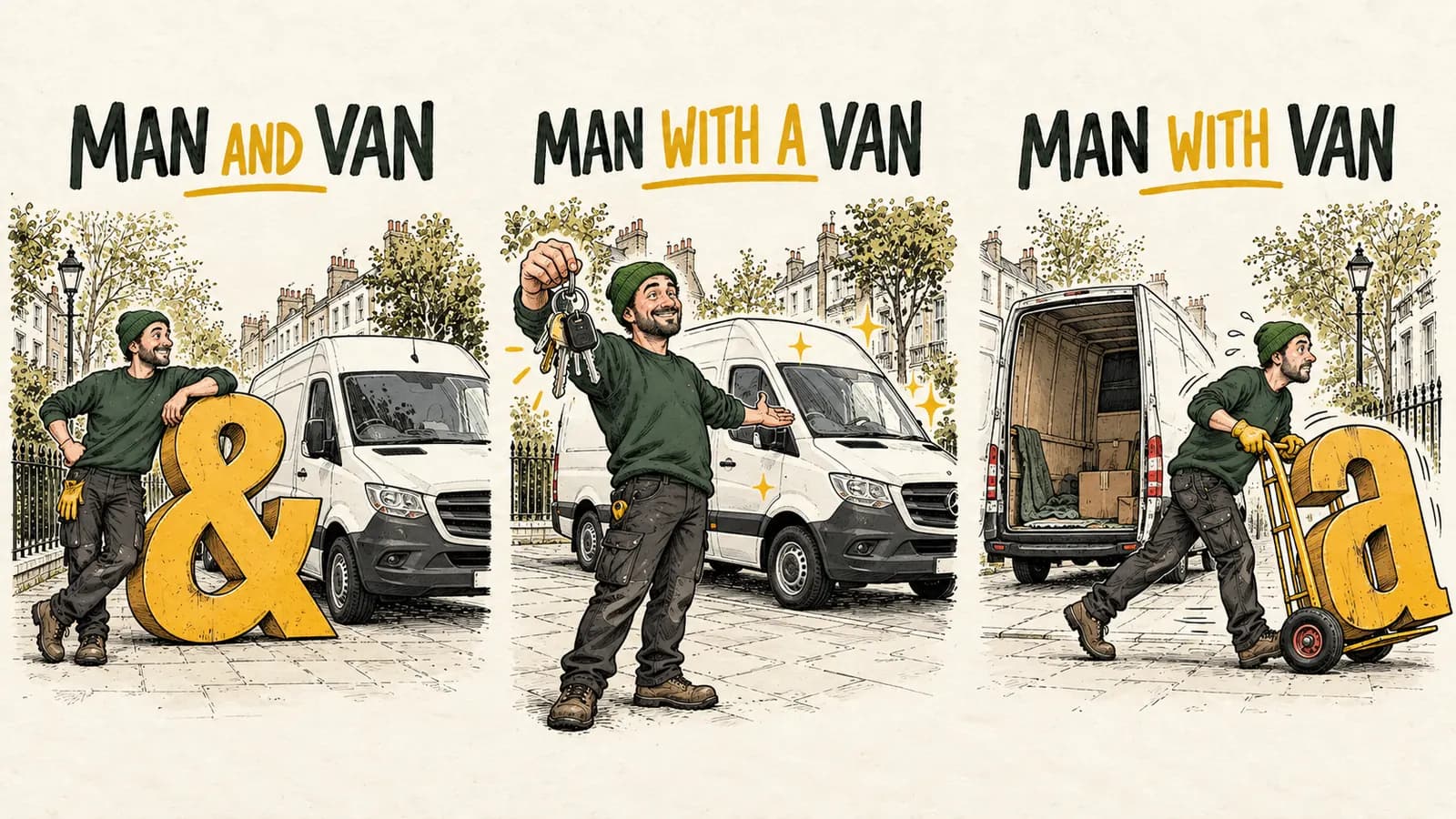
Faced with a wardrobe that will not fit in a hatchback, the British public has a choice. It can summon a man and van, or a man with a van. Either way, the wardrobe remains the same size.
The distinction is small but pleasing. “Man and van” presents two equal partners in an enterprise. “Man with a van” gives the man top billing and establishes that he has remembered to bring the transport. Neither tells you whether the wardrobe will fit through the front door.
Then there is “man with van”, which retains the essential relationship while dispensing with the indefinite article. Before a single piece of furniture has been removed, someone has already got rid of an unnecessary “a”.
For anyone advertising a removals business, however, the wording raises a practical question. What do people actually call the service? And does the answer change depending on where they live?
There is some evidence that it does.
A Google Trends comparison covering November 2021 to October 2026, using searches containing the three exact phrases, puts “man with a van” ahead across the United Kingdom. Its average search interest index was 62, against 51 for “man and van” and 22 for “man with van”. These are relative indices, not numbers of searches.
The geographical breakdown is more revealing. Within this three phrase comparison, “man with a van” accounted for 48 per cent of the combined interest in England, 54 per cent in Wales, 63 per cent in Scotland and 65 per cent in Northern Ireland.
“Man and van”, meanwhile, accounted for 37 per cent in England but only 17 per cent in Northern Ireland. “Man with van” occupied a steadier position, with shares ranging from 15 to 18 per cent across the four countries.
England, apparently, is considerably more willing to replace a preposition with a conjunction. The missing “a” attracts less regional controversy.
These figures need handling with rather more care than a box marked “miscellaneous”. As Google explains its methodology, Trends uses sampled searches and reports relative interest. It does not count the number of people who would use an expression in conversation. The results suggest a geographical preference in search wording; they do not establish a new dialect boundary.
There is also a small trap in the research. Enter the words without quotation marks and Google can include searches containing them in a different order. Its instructions for phrase searches explain that quotation marks preserve the wording, while still allowing extra words before or after it. Even an investigation into van hire requires someone to read the instructions.
The business itself is rather older than the search box.
The Online Etymology Dictionary dates the vehicle sense of “van” to 1829, as a shortening of “caravan”. It originally described a covered wagon, particularly one used for furniture and household goods. The van was helping people move house before anyone had thought to put an engine in it.
Historian Richard Jones points to an advertisement in the Chelsea News and General Advertiser of 24 May 1884. J. Nielsen offered a “horse, good furniture van and man” for one shilling an hour.
The horse has since disappeared from the standard quotation. The hourly rate has proved more durable.
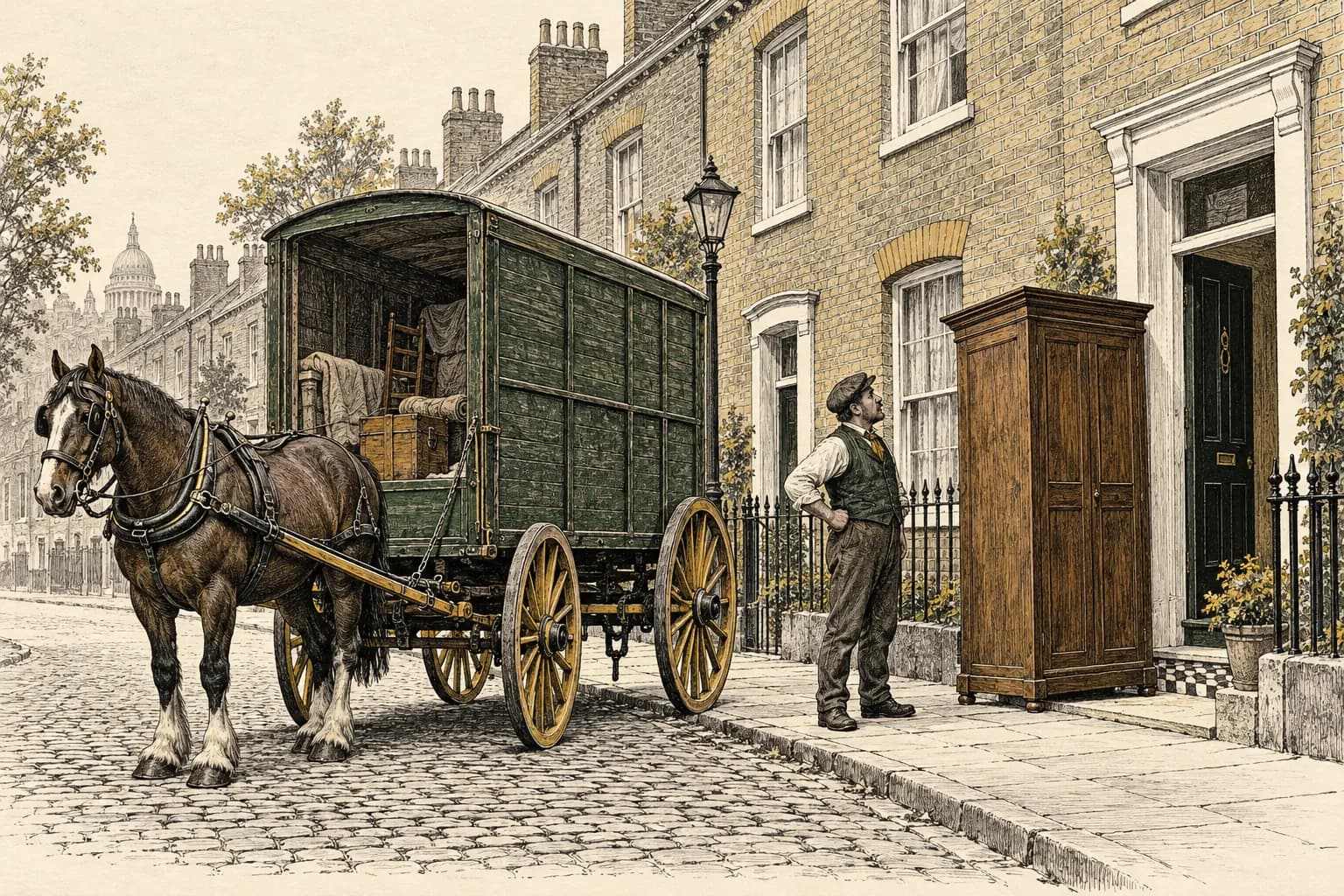
That advertisement describes an ancestor of the modern service, rather than the first appearance of any of our three expressions. It would be convenient to discover that “man and van” was invented on a particular Tuesday in Chelsea. The evidence does not oblige.
A more recognisable account comes from Surrey. In its history of the business, Steve Frieze Removals recalls starting in 1970 with a single van and advertising in local newspapers as a “man with a van”. The company’s timeline describes a grocery shop owner in Reigate lending out his blue Transit, discovering that it was being used for small removals, and deciding to enter the trade himself.
This is a retrospective account, rather than a surviving advertisement from 1970. It nevertheless offers a useful reminder of the practical circumstances behind the expression: someone had a van, someone else had furniture, and an arrangement followed.
For evidence we can inspect in the original publication, the newspaper classifieds are particularly helpful.
The 10 March 2005 edition of Oxford’s Daily Info carried an advertisement beginning: “SMALL MOVES. Man and van: removals, deliveries etc.”
The same issue charged 40p a word, with a ten word minimum, plus VAT. Brevity had a price attached to it. That does not prove that advertising charges created the shorter expression, but it does suggest an environment in which unnecessary words were unlikely to prosper.
“Man and van” also has the compactness of a shop window notice. It announces the available resources and leaves the reader to supply the furniture.
The third version was there too. In Daily Info’s edition of 1 to 7 September 2006, an advertiser offered local and national removals under the heading “MAN WITH VAN”. Whatever its earlier history, the phrase was already doing useful work in printed classified advertisements.
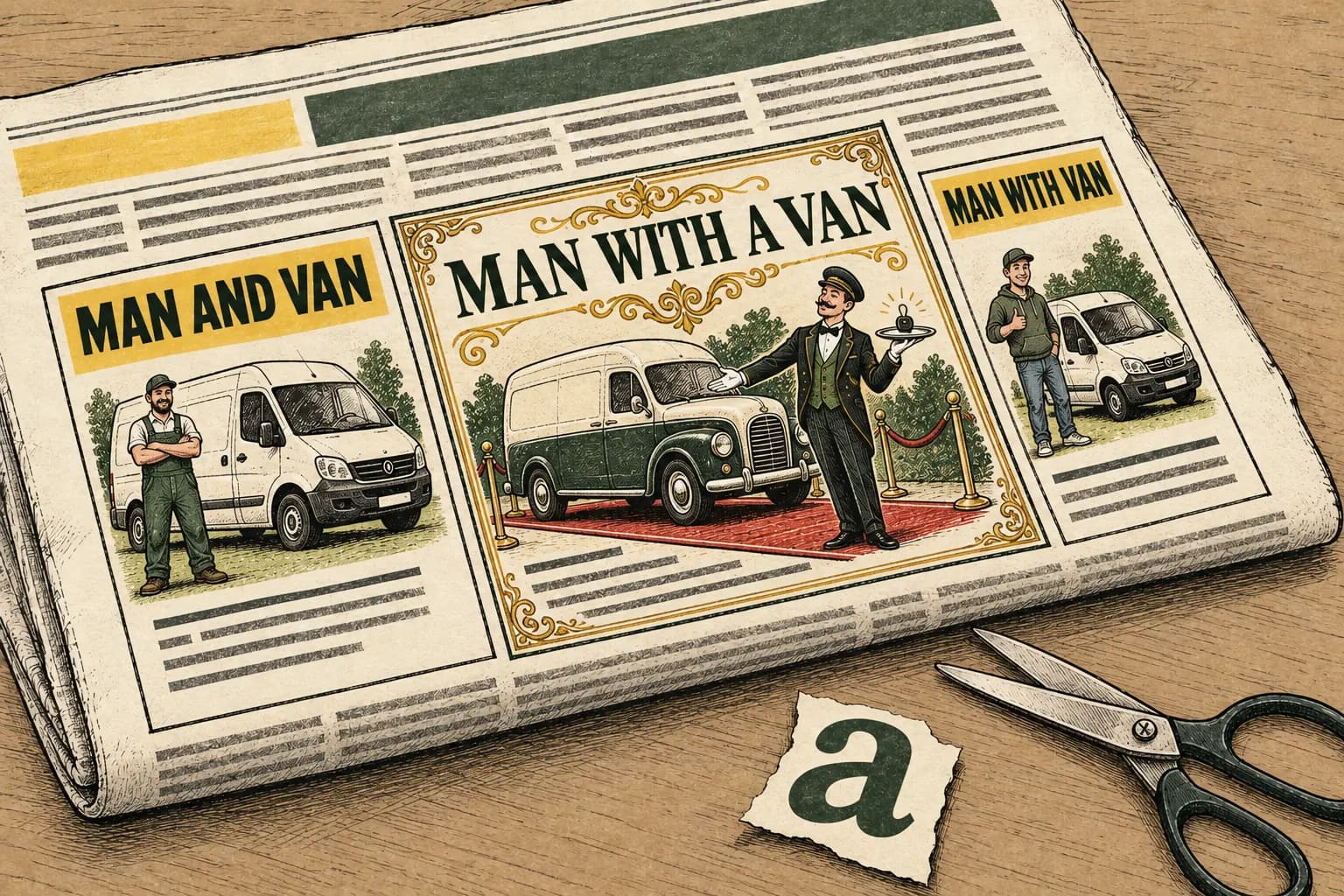
There is nothing particularly mysterious about its grammar. Cambridge’s English Grammar Today explains that newspaper headlines frequently leave out articles such as “a” and “the”, along with other words readers can supply for themselves. “Man with van” fits that familiar pattern of compression.
We do not need to imagine that the advertiser had forgotten how sentences worked. An advertisement is allowed to behave like an advertisement. “Flat to let” does not usually provoke demands to know where the verb has gone.
This offers a plausible explanation for the wording, rather than a documented account of its invention. It also explains why the missing article causes so little practical difficulty. Nobody reading “man with van” is likely to telephone and ask whether the vehicle is included.
By September 2011, Daily Info was accommodating all three versions at once. Its services listings included “MAN AND VAN”, “MAN WITH A VAN”, “MAN WITH VAN” and the particularly promising “VAN AND HELPFUL MAN”.
All appeared in the same edition. Advertisers were offering removals and deliveries under the different expressions, which makes it difficult to argue that the wording denoted three distinct trades.
The helpful advertiser had perhaps identified the more useful distinction. The presence of a van was encouraging. Helpfulness was what you wanted when the sofa reached the landing.
There is an even neater example in the paper’s February 2014 listings. An advertisement headed “MAN AND VAN” directed readers to a website whose address contained “a man with a van”. One business was using both expressions in the same small advertisement.
This was admirably relaxed. Anyone attempting to establish separate linguistic territories would first have had to persuade the advertiser to stop occupying both.
Nor was this variety confined to Oxford. In Newton News, serving Newton Aycliffe, on 15 September 2017, a “MAN WITH VAN” offered removals and clearances, while Acorn Removals and Deliveries advertised as “MAN AND VAN”.
The examples establish coexistence in particular places and years. They cannot tell us which expression every customer preferred, or whether an advertiser used different wording when answering the telephone. But they do show that the variations were familiar enough to be printed without explanation.
There is a distinction here between the history of a service and the history of its name. An account of a business starting in 1970 does not establish that its chosen phrase began in 1970. Finding an advertisement in 2006 proves that the wording was in use then, not that nobody had thought of it before.
Small advertisements are particularly awkward witnesses. They were written to find someone who needed a sofa moved that week. Preserving evidence for future students of the indefinite article was unlikely to have featured in the brief.
Popular culture supplies another variation, although not necessarily a sound business plan.
In Peep Show, Super Hans proposes that another van could turn the enterprise into “men with ven”. The joke applies the irregular plural of “man” to a vehicle that had been managing perfectly well with an ordinary “s”.
The Dublin business eVan Transportation credits the scene with helping inspire its own beginnings. In a first person account, the writer recalls watching the programme and finding that the idea of starting a van business stayed with him.
Super Hans is an unusual figure to encounter in a company’s founding history. Still, the connection illustrates how easily the expression travels between an advertisement, a television joke and an actual business. The audience is expected to understand the occupation before the grammar goes wrong.
It would be a considerable leap to credit a sitcom with the popularity of any particular search term. The more modest observation is that this was a recognisable way of earning a living, familiar enough for the wording itself to become the joke.
Taken together, the evidence suggests a vocabulary shaped by ordinary speech, compact advertising and local preference. The three expressions have coexisted in the same market. Modern search data shows that their relative popularity varies across the country, without dividing Britain neatly into opposing camps.
There is no basis here for declaring one expression more professional, more traditional or more trustworthy. Nor does the extra word promise an extra pair of hands. Those are details to establish when booking.
A customer still needs to know the size of the van, who will carry the furniture and how the charge is calculated. None of the three expressions settles those questions. All are admirably economical descriptions of a service whose practical details require a little more conversation.
The wardrobe, meanwhile, is still waiting.
The most useful word in the advertisement may have been “helpful” all along.
Have something that needs moving? Book your move
Back to guides & articles